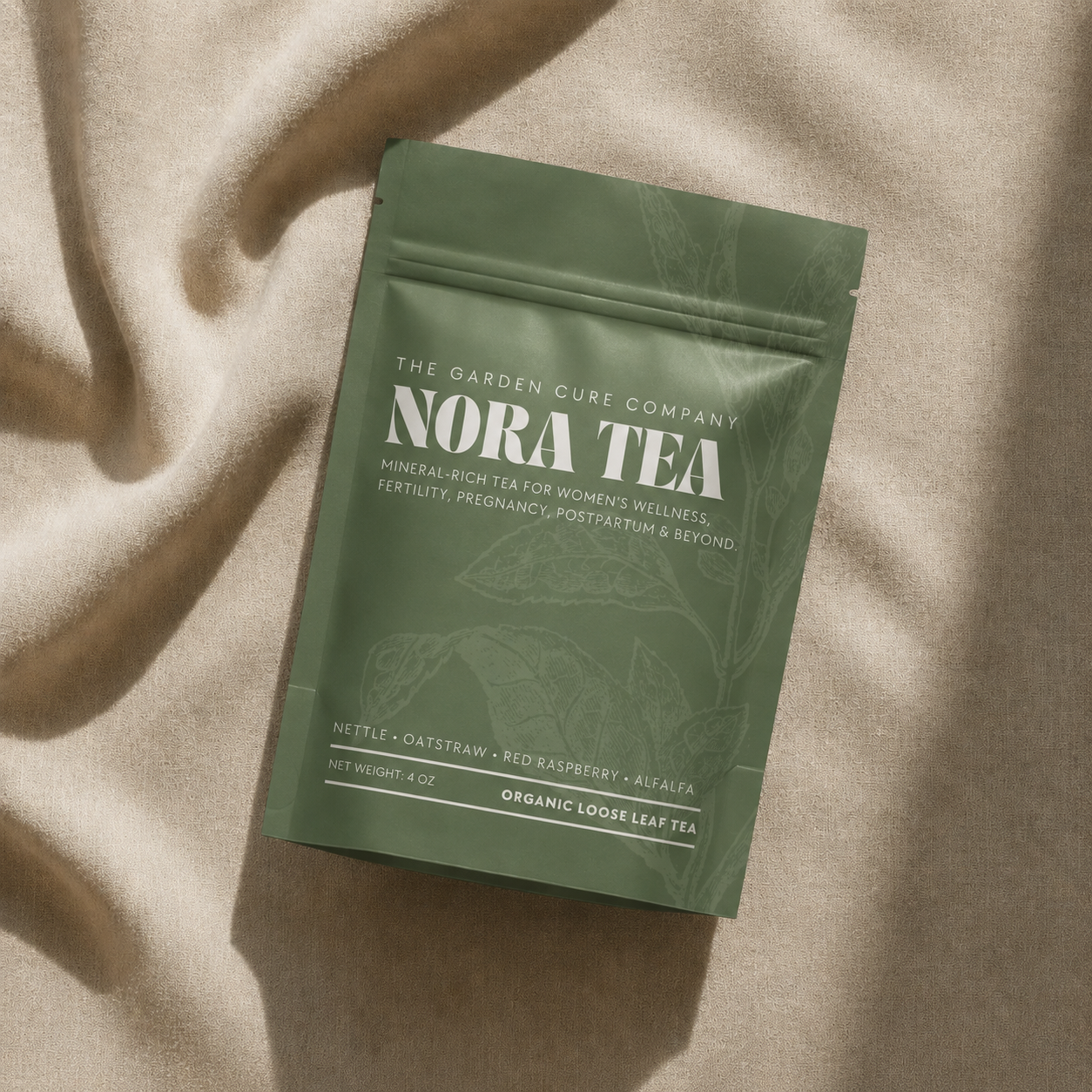
NORA TEA
Add ¼ cup of herbs to 1 quart of freshly boiled water, cover, and allow to steep 4–8 hours or overnight. Strain and enjoy warm or chilled throughout the day.
For a lighter tea, steep for 20–30 minutes before straining.
Optional: Add a splash of lemon juice or apple cider vinegar to enhance mineral absorption.
Nettle (Urtica dioica), Oatstraw (Avena sativa), Red Raspberry Leaf (Rubus idaeus), Alfalfa (Medicago sativa)
✔️ Women in the second and third trimesters of pregnancy
✔️ Those looking for gentle, mineral-rich daily nourishment
✔️ Women preparing for birth and supporting overall uterine wellness
✔️ Postpartum mothers looking to replenish and restore
✔️ Women seeking traditional herbal support through menstruation, fertility, pregnancy, postpartum, and beyond
For the first trimester, choose NOA Tea, our red-raspberry-leaf-free blend formulated for early-pregnancy nourishment.
These statements have not been evaluated by the Food and Drug Administration. This product is not intended to diagnose, treat, cure, or prevent any disease. The information provided is for educational purposes only and is not a substitute for professional medical advice. Use at your own discretion. If you are pregnant, nursing, taking medication, or have a medical condition, please consult your healthcare provider before use.
Frequently asked questions
Yes, this blend is designed for gentle, long-term nourishment and daily support.
No. All minerals come from whole, plant-based herbs traditionally used for nourishment.
NORA is designed for the second and third trimesters of pregnancy, as it contains red raspberry leaf. For the first trimester, choose NOA Tea, our mineral-rich blend formulated without red raspberry leaf.
NOA and NORA were created to support different stages of pregnancy. NOA is our gentle, mineral-rich blend made without red raspberry leaf, making it the go-to choice for the first trimester.
Red raspberry leaf is omitted from NOA because it’s traditionally used later in pregnancy, particularly as a uterine tonic, and research on its use during the first trimester is limited. We leave it out of our first-trimester blend as a more conservative approach, then introduce it in NORA for the second and third trimesters.